
Last updated September 22, 2026
Free on-site gate assessment - hinges, posts, and your LiftMaster or Nice gate operator checked before anything is quoted
The assessment is free and the quote is the invoice.
 Before
 After
After Before
 After
After Before
 After
AfterThe Complete Guide to Gate Repair in Scottsdale
The motor on a typical swing gate outlasts three sets of hinges and two control boards. So when your Scottsdale gate fails, the motor probably isn’t what broke. We’ve repaired over 22,000 gates since 2014, and the pattern is consistent: homeowners replace motors that still have years of life while ignoring the limit switches, ground-level hardware, and control board wiring that actually caused the failure. In Scottsdale’s 115-degree summer cycle, these overlooked systems degrade faster than almost anywhere else in the country. This guide maps the real failure chain, teaches you to read your gate’s behavior as diagnostic language, and shows you what gate repair documentation looks like so you never pay twice to rediscover the same problem.
Quick Answer
Gate repair in Scottsdale typically addresses limit switch drift, hinge seizure, or control board faults caused by heat cycling and caliche soil conditions, as detailed in our Gate Repair Cost Breakdown: The Scottsdale Homeowner’s Reference for 2026. Most residential repairs run $180-$650 depending on whether the issue is mechanical adjustment, component replacement, or electrical fault tracing. A complete repair includes written scope, written price before work starts, and photographic documentation of every adjustment and part installed.
Table of Contents
- The Real Failure Hierarchy: What Breaks First, Second, and Third in Scottsdale
- Reading Your Gate’s Behavior: Diagnostic Language Before You Call
- Complete Repair Scope vs. Patch: How to Tell Which You’re Being Sold
- The Documentation You Should Have on File After Every Repair
- Why Scottsdale’s Caliche Soil and Underground Conduit Create Recurring Faults
- Working With What You Have: Nine Automation Brands and Parts Strategy
- What Gate Repair Costs in Scottsdale: Real Price Ranges
- Preventive Maintenance That Actually Works in Desert Conditions
 Before
 After
AfterThe Real Failure Hierarchy: What Breaks First, Second, and Third in Scottsdale
Scottsdale’s climate creates a specific degradation sequence that most gate companies don’t explain. Understanding this hierarchy saves you from replacing a $900 motor when a $45 limit switch was the actual failure.
First Failure: Limit Switches
The limit switch tells the motor when to stop opening and when to stop closing. It’s a small mechanical or magnetic sensor that sits in the motor housing or on the gate frame. In Scottsdale, it fails first for two reasons.
Heat cycling. Every summer day in Scottsdale, your gate motor housing reaches 140-160 degrees internally. Every evening, it cools. That expansion and contraction loosens the limit switch mounting, shifts the actuator arm, or degrades the magnetic sensor’s calibration. By year three or four, the switch that was set to stop the gate at 90 degrees of swing is stopping it at 87 degrees, then 84. The gate starts hitting the stop post, or stopping short of full close.
Dust infiltration. Our spring dust storms force fine particulate past motor housing seals. On limit switches with exposed contacts, that dust creates resistance that the control board reads as position error. The board compensates until it can’t, then throws a fault code or simply stops responding.
We’ve replaced maybe 200 motors in Scottsdale in a decade. We’ve reset or replaced thousands of limit switches. The ratio isn’t close.
Second Failure: Ground-Level Hardware
Hinges, rollers, and track hardware live in the most hostile environment on the gate assembly. In Scottsdale, that means:
- Thermal expansion in direct sun: A steel hinge pin in a Scottsdale afternoon expands enough to bind in its brass bushing. The motor strains, draws more amperage, and the control board records an overload fault.
- Caliche dust in grease: Our alkaline soil dust is abrasive. When it mixes with hinge grease, it forms a grinding paste that accelerates wear. We see hinge pins worn .030″ out of round in five years in Arcadia and McCormick Ranch properties where irrigation keeps dust active.
- Gate sag from footing settlement: Scottsdale’s expansive clay and caliche layers shift with seasonal moisture changes. A gate that swung freely in March drags in August. The motor works harder. The limit switches, already drifting, can’t compensate.
Ground-level hardware failure is mechanical, visible, and often ignored until it damages the motor or control board. A complete repair inspects and addresses it before touching electrical components.
Third Failure: Control Board and Wiring
The control board is the computer that reads sensors, manages motor speed, and stores fault history. In Scottsdale, it fails third, but often gets blamed first because it’s where symptoms become visible.
Heat is the primary killer. Capacitors on gate control boards are rated for 85°C operation. In an unshaded Scottsdale motor housing, ambient hits 70°C regularly. Add current load, and those capacitors degrade. We’ve opened FAAC and Linear boards where the electrolytic capacitors have vented their electrolyte through the pressure relief scored into the aluminum can. The board still works, intermittently, until it doesn’t.
Voltage fluctuation from utility loading during summer peak demand compounds the problem. Scottsdale’s grid sees heavy air-conditioning load July through September. That voltage sag, repeated daily, stresses power supply components already running at thermal limit.
When a control board fails after limit switch drift and hinge binding have already stressed the motor, replacing the board alone guarantees a callback. The complete repair addresses the chain, not the symptom.
Reading Your Gate’s Behavior: Diagnostic Language Before You Call
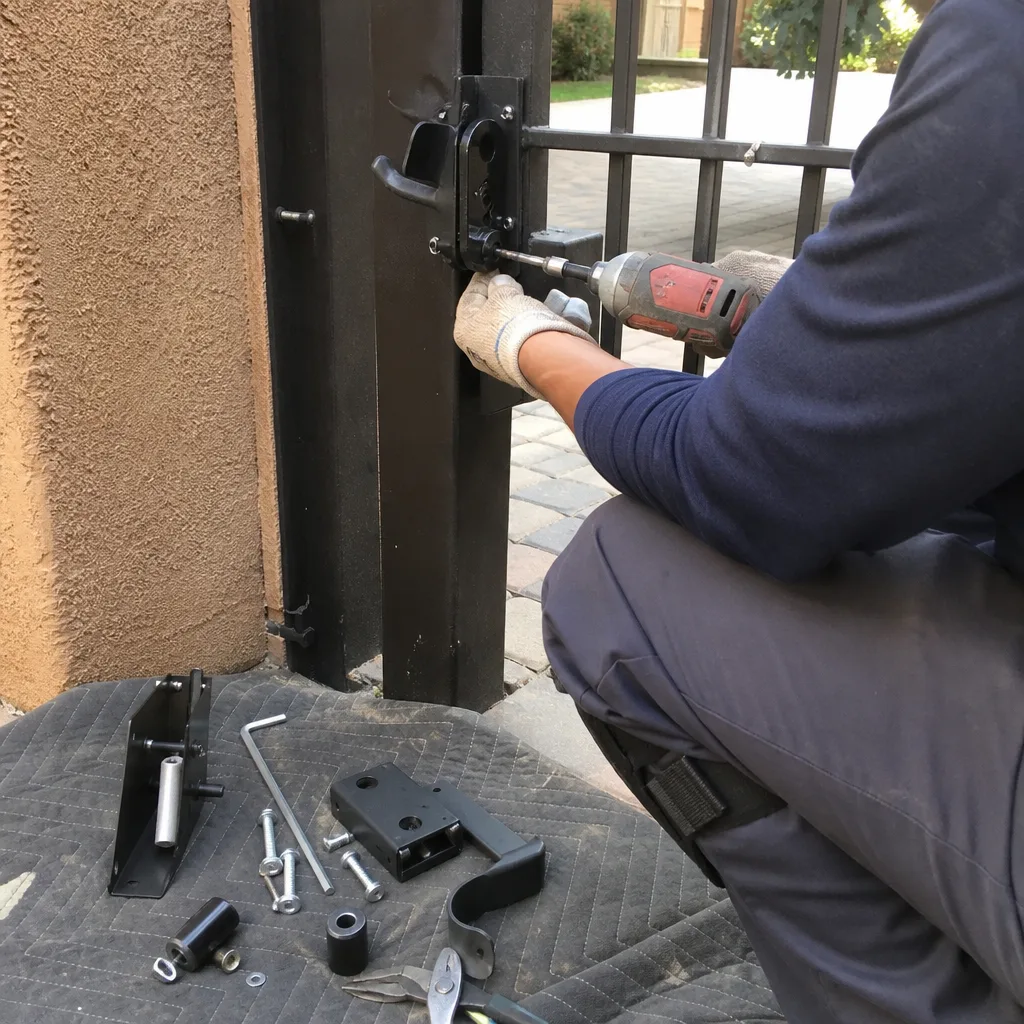
Your gate tries to tell you what’s wrong before it fails completely. The pattern of behavior is specific enough that you can narrow the problem to one or two systems before a technician arrives.
Slow Close, Normal Open
If the gate opens at normal speed but closes slowly, or starts normal and decelerates prematurely, the close limit switch is drifting or the close-cycle amperage threshold is set too low. In Scottsdale heat, we see this most often on gates with FAAC 415 or Linear SWD operators where the limit cam has thermally expanded and shifted. The motor thinks it’s hitting resistance and ramps down to protect itself.
Check: Does the gate close fully if you hold the remote button? If yes, it’s almost certainly limit switch or amperage setting, not mechanical binding.
Hard Stop or Jerk at Either End
A gate that slams to a stop, reverses abruptly, or jerks at the open or close position has a limit switch that’s completely out of set. The motor drives until the physical stop block catches it, or until the amperage spike triggers the safety reverse. This stresses the gate frame, the hinges, and the motor gearbox. Continuing to operate it this way will crack aluminum arms or strip nylon gears.
Reverses Without Obstacle
The photo-eye (the infrared beam that stops the gate if something crosses the path) is the usual suspect, but not the only one. In Scottsdale, we find:
- Photo-eye misalignment from thermal expansion: The mounting bracket shifts in heat. The beam misses the receiver by a fraction. The gate reverses as if interrupted. We measure this in the field: a bracket that was square at 8 AM can be 2 degrees off by 2 PM.
- Reflected sunlight interference: Direct afternoon sun into the receiver lens overwhelms the infrared signal. Viking and some DoorKing photo-eyes are particularly susceptible. The fix is a hood, a reposition, or an upgraded beam frequency, not a motor replacement.
- Amperage spike from binding hardware: The motor draws more current, and the control board interprets it as an obstruction. The gate reverses. The photo-eyes are fine. The hinges are the problem.
Intermittent Operation, No Pattern
This is the hardest symptom and often the most expensive if misdiagnosed. Intermittent faults point to:
- Loose wire terminal in underground conduit (vibration, thermal cycling, or caliche pressure)
- Control board capacitor failing under thermal load
- Transformer output sagging when utility voltage drops
- Intermittent short in low-voltage control circuit
The critical diagnostic step: note the time of day, the temperature, and whether the gate failed on open or close. Pattern data cuts diagnostic time by half. A gate that fails only between 2 PM and 6 PM in July has a thermal problem. A gate that fails randomly regardless of temperature has a connection problem.
Complete Repair Scope vs. Patch: How to Tell Which You’re Being Sold
Most Scottsdale homeowners have experienced a patch disguised as a repair. The technician resets the limit switch, collects the fee, and leaves. Three months later, the same symptom returns because the hinge binding that caused the limit switch to drift was never addressed.
Here’s how to distinguish complete repair from patch work.
The Patch: What It Looks Like
- Single-symptom fix with no system inspection
- No written scope beyond the invoice line item
- No photos of findings or adjustments
- No measurement of hinge resistance, amperage draw, or voltage at the board
- Verbal warranty, or none stated
We’ve been called to follow up on these. The limit switch was reset. The hinge pin was binding at 12 foot-pounds of torque instead of the 3 foot-pounds the motor is rated for. The board was logging overload faults that were never checked. The customer paid twice.
The Complete Repair: What It Includes
- Mechanical baseline: Hinge resistance measured with a torque wrench. Track alignment checked with a level. Gate frame inspected for twist or sag. Ground-level hardware lubricated with appropriate grease for desert conditions, not whatever was in the truck.
- Electrical baseline: Voltage at the board under no-load and running conditions. Amperage draw on open and close cycles. Limit switch position verified against physical gate position, not just “it seems to stop in the right place.”
- Component condition assessment: Capacitor inspection on the control board. Photo-eye alignment measured, not eyeballed. Transformer output checked against manufacturer spec.
- Corrective work with written scope: Every item adjusted or replaced is named, with part numbers. The price for each is listed before work starts.
- Documentation delivered: Photos of every finding and every adjustment. Written record of limit switch settings, amperage readings, and part numbers installed. This is Vance Gate Repair Scottsdale home practice under The Haven Standard, Clause 4.
Under our 365-Day Done Right Promise, if any repair isn’t right, we make it right with no argument, no fee, and no expiration within that year. A patch artist can’t offer that because they know the callback is coming.
The Documentation You Should Have on File After Every Repair
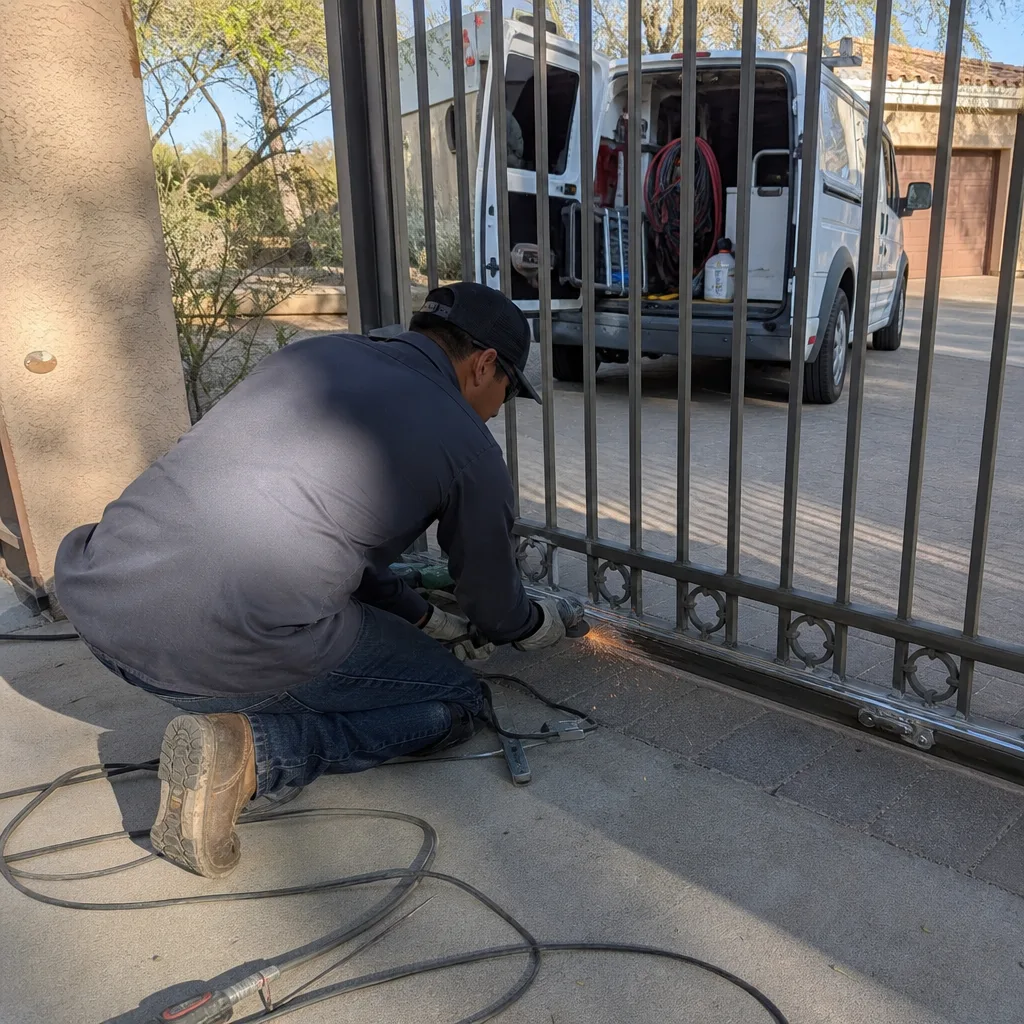
Most homeowners file the invoice and forget the details. When the gate fails again in two years, neither they nor the next technician knows what was done. The problem gets rediscovered at full diagnostic cost.
After a complete repair, you should have these four documents:
1. The Written Scope and Price
This is The Haven Standard Clause 1: the flat price, itemized by component, delivered before any work starts. Not an estimate. A fixed price. If the technician finds additional issues, the scope expands and the price is rewritten before proceeding. You should never receive an invoice larger than the number you approved.
2. The Wiring Diagram or Connection Record
For any electrical work, the technician should document what was connected where. On a control board replacement, this means terminal numbers and wire colors. On a photo-eye reposition, this means the new mounting location and beam path. Adrian Vance developed this habit on commercial access-control sites starting in 2014, where undocumented wiring meant hours of reverse-engineering on the next service call. Residential gates deserve the same discipline.
3. The Limit Switch and Adjustment Record
The exact limit switch settings: open stop position in degrees, close stop position, deceleration point if adjustable, amperage thresholds for obstruction detection. With this record, any future technician can determine whether the gate has drifted from baseline or whether a new problem has developed.
4. The Photographic Evidence
Before-and-after photos of every component accessed. The worn hinge pin. The capacitor that vented. The photo-eye beam path. The final position of the limit switch cam. These photos belong to you, not just the company’s job file. Under Clause 4, we leave a copy with the homeowner and file the master set in our records.
We’ve returned to Scottsdale homes where the previous company left nothing but a one-line invoice reading “repaired gate.” The homeowner paid $400 for work that took 20 minutes and left no trace. That’s not service. It’s a transaction.
Why Scottsdale’s Caliche Soil and Underground Conduit Create Recurring Faults
This is the failure mode most gate companies in Scottsdale miss entirely, because it requires understanding local geology, not just gate mechanics.
The Caliche Problem
Caliche is a cemented layer of calcium carbonate that forms in desert soils. In Scottsdale, it sits anywhere from 6 inches to 3 feet below surface grade, depending on location and historical grading. It’s hard enough to require pneumatic tools to penetrate. It’s also expansive: it swells when wet and contracts when dry.
Gate installers run low-voltage control wire and 120V power in PVC conduit buried below frost line. In Scottsdale, there’s no frost line, but installers still bury conduit 18 inches deep out of habit. If that depth intersects caliche, three problems develop.
Compression: Seasonal expansion of caliche squeezes PVC conduit. Over years, the conduit deforms. Wire insulation chafes at stress points. Eventually, a bare conductor contacts the conduit wall or another conductor. The fault is intermittent at first, worsening with moisture.
Grounding fault: Caliche is conductive when moist. A compromised hot conductor leaking to ground through caliche creates a path that doesn’t trip the breaker (resistance is too high) but disrupts control board logic. The gate behaves erratically. The symptom looks like a board failure. The cause is 18 inches underground.
Impossible pull: When conduit fails, standard repair is to pull new wire. In caliche-compressed conduit, the pull is impossible without excavation. Many technicians don’t own the equipment or don’t want the job. They run surface wire instead, which degrades faster in sun and becomes a trip hazard.
What Complete Repair Looks Like
A technician who understands Scottsdale conditions will:
- Megger-test (insulation resistance test) the underground run before blaming the control board
- Document conduit condition with a borescope inspection if accessible
- Propose trenching and direct-burial rated cable in new conduit if the existing run is compromised
- Never run surface wire across a driveway as a permanent solution
We’ve traced “intermittent board failure” on a BFT operator in North Scottsdale to a crushed conduit section where caliche had compressed the PVC into an oval. The wire insulation was intact but thinned. Every summer rain, ground conductivity increased enough to leak voltage and scramble the board. The motor was fine. The board was fine. The conduit was the problem. Surface-level repair would have replaced both and left the actual fault.
This is why gate repair in Scottsdale requires local geological awareness, not just technical training.
Working With What You Have: Nine Automation Brands and Parts Strategy
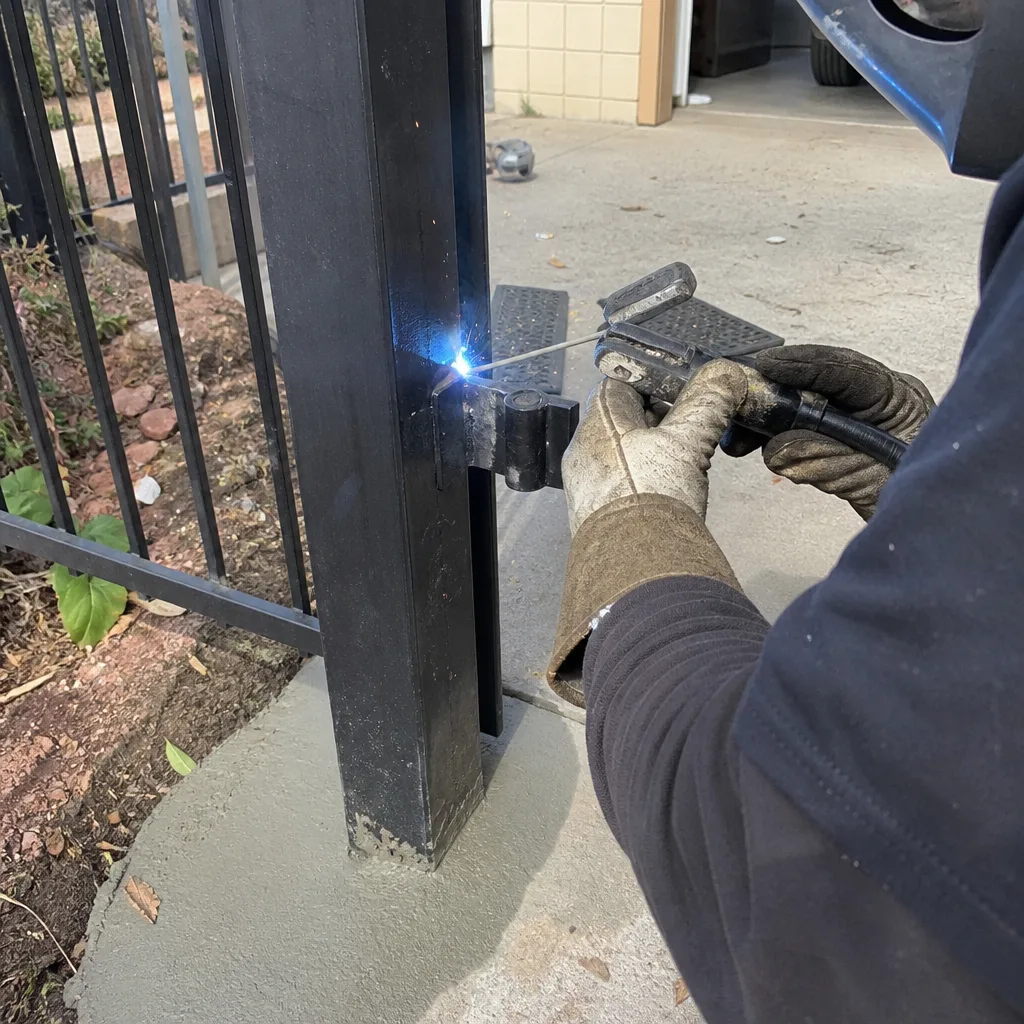
Vance Gate Repair services nine major automation brands: LiftMaster, FAAC, BFT, Linear, Viking, Ghost Controls, DoorKing, Elite, and Mighty Mule. See our more guides & resources for brand-specific maintenance tips. We don’t steer customers toward replacement to simplify our inventory. Each brand has specific failure patterns in Scottsdale conditions, and each has repair strategies that extend service life.
Brand-Specific Scottsdale Notes
FAAC: Italian hydraulics, common in high-end Scottsdale installations from the 2000s. The 415 and 402 models use mineral oil that thickens below 40°F, irrelevant in Scottsdale but the thermal design assumes European temperature ranges. In 115°F ambient, the oil thins, internal leakage increases, and the gate slows. We see this misdiagnosed as motor weakness. The fix is often seal replacement and oil change to higher viscosity grade, not motor replacement.
BFT: Similar hydraulic lineage. The SUB and ARES swing operators have a manual release mechanism that corrodes in our alkaline dust. We document the release operation in every service record because a homeowner who can’t release the gate during a power outage has an emergency, not an inconvenience.
Linear: Widespread in Arizona residential for cost and availability. The SWD and PRO models use DC motors with Hall-effect limit sensors. The sensors fail from heat before the motor does. We stock the sensor modules specifically because they’re a 30-minute repair versus a full operator replacement.
Viking: Premium residential and light commercial. The access-control integration is robust, but the early-generation boards had capacitor issues we’ve documented extensively. Our repair records for Viking operators in Scottsdale include capacitor replacement at 6-8 year intervals as preventive maintenance.
The Parts Philosophy
We repair with OEM parts where available, quality aftermarket where OEM is obsolete, and we document the source in every record. “Replaced with compatible module” is different from “replaced with OEM part number 12345.” Both are valid. Both should be stated.
The Haven Standard requires that you know what was installed, who made it, and whether it carries the manufacturer’s warranty or ours. For gate motor and opener service in Scottsdale, that transparency matters because motor replacement is the most expensive single component, and the most commonly oversold.
What Gate Repair Costs in Scottsdale: Real Price Ranges
Price visibility is Haven Standard Clause 1. These ranges reflect our actual Scottsdale pricing as of 2024, adjusted for desert-market conditions. Every job gets a written, itemized quote before work starts.
| Service Category | Typical Range | What Affects Price |
|---|---|---|
| Limit switch reset or replacement | $180-$280 | Brand access, whether switch is standalone or integrated into motor housing |
| Hinge service (pin, bushing, lubrication) | $220-$380 | Number of hinges, material (steel vs. aluminum), whether gate must be supported during work |
| Photo-eye alignment or replacement | $160-$290 | Single vs. dual beam, whether new conduit run required |
| Control board repair (capacitor, terminal) | $240-$420 | Board accessibility, whether programming must be restored from backup |
| Control board replacement | $580-$1,100 | Brand, features (soft start, obstacle sensitivity, access control integration) |
| Underground conduit/wire fault repair | $340-$780 | Length of run, caliche penetration required, permit if crossing sidewalk |
| Complete diagnostic with written report | $150-$220 | Applied to repair if authorized; standalone if no repair performed |
These are ranges, not quotes. Your specific price depends on what we find. The price we write is the price you pay. We don’t invoice for “additional labor” discovered mid-job unless you approve a rewritten scope.
We also offer a free second opinion on any written estimate from another company. Bring the paperwork. We’ll review it, inspect the gate, and tell you whether the scope matches the symptoms. No charge, no obligation.
Preventive Maintenance That Actually Works in Desert Conditions
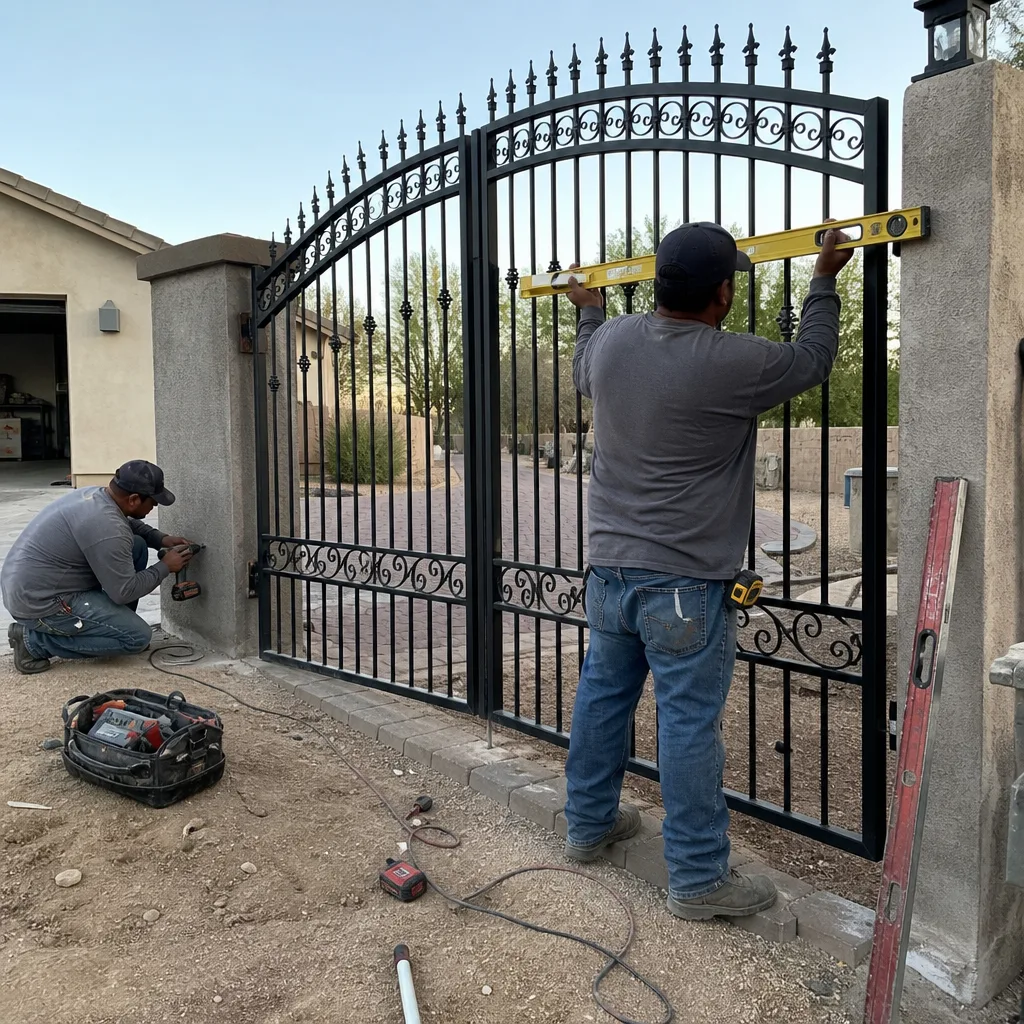
Gate maintenance in Scottsdale is different from maintenance in temperate climates. The standard advice (“lubricate annually”) is insufficient and sometimes harmful if the wrong lubricant is used.
What to Do Every Six Months
- Hinge torque check: Open and close the gate manually. It should move at 3-5 foot-pounds of resistance. If it’s stiffer, disassemble, clean old grease and caliche dust, relubricate with lithium-based grease rated for 300°F. Petroleum-based grease attracts dust and becomes grinding paste.
- Limit switch verification: With the gate in full open and full close positions, verify the physical stop matches the switch indication. On operators with position display (FAAC, some Linear models), note the degree reading. Drift of more than 2 degrees from baseline means adjustment is needed before failure.
- Photo-eye alignment and cleaning: Clean lenses with lint-free cloth. Check alignment with a level. In Scottsdale, check specifically for afternoon sun interference; if the receiver lens faces west, a hood may be needed.
- Control board thermal inspection: Open the motor housing when the gate has been idle for an hour. Look for capacitor doming (the top should be flat, not convex) or electrolyte residue. Smell for ozone or hot plastic. These are pre-failure indicators visible months before the board fails.
- Conduit and surface wire inspection: Walk the wire run. Look for sun-bleached insulation, rodent damage, or areas where surface wire has been driven over. In Scottsdale, UV degradation of PVC insulation is real; gray-sheathed cable becomes chalky and cracks.
What to Avoid
Don’t pressure-wash the motor housing. Water forces past seals and sits in the bottom of the enclosure, accelerating corrosion. Don’t use WD-40 on hinges; it’s a solvent, not a lubricant, and evaporates in days. Don’t ignore a gate that “mostly works.” Intermittent operation is early warning, not inconvenience.
For gate installation in Scottsdale, we specify conduit depth and material for caliche conditions, and we leave maintenance documentation with every new gate. But most Scottsdale gates are already installed. Maintenance on existing equipment is where most value is recovered.
Common Mistakes to Avoid
- Replacing the motor first: In our Scottsdale records, motors are the actual failure less than 15% of the time. The motor is the most expensive component and the easiest to sell. Demand diagnostic evidence before authorizing motor replacement.
- Accepting verbal scope: “We’ll fix it” is not a scope. “Reset limit switch, lubricate hinges, verify photo-eye alignment, test amperage draw” is a scope. Get it in writing before work starts.
- Ignoring seasonal patterns: A gate that fails every July has a thermal problem, not a random defect. Seasonal pattern data is diagnostic gold that most homeowners don’t record.
- Running surface wire as permanent repair: In Scottsdale sun, surface wire degrades in 2-3 years. It’s a trip hazard and a code violation across driveways. Insist on proper burial or conduit.
- Skipping the documentation: The technician who won’t photograph their work or write down part numbers is the technician who doesn’t expect to return. Documentation is accountability.
- Using the wrong lubricant: Standard lithium grease for desert conditions, not multipurpose spray. Not graphite on outdoor hinges (washes out). Not motor oil (attracts dust).
- Waiting for total failure: A gate that reverses intermittently, stops short, or makes new noise is telling you something. Address it at diagnostic cost, not emergency repair cost.
When to Call a Professional
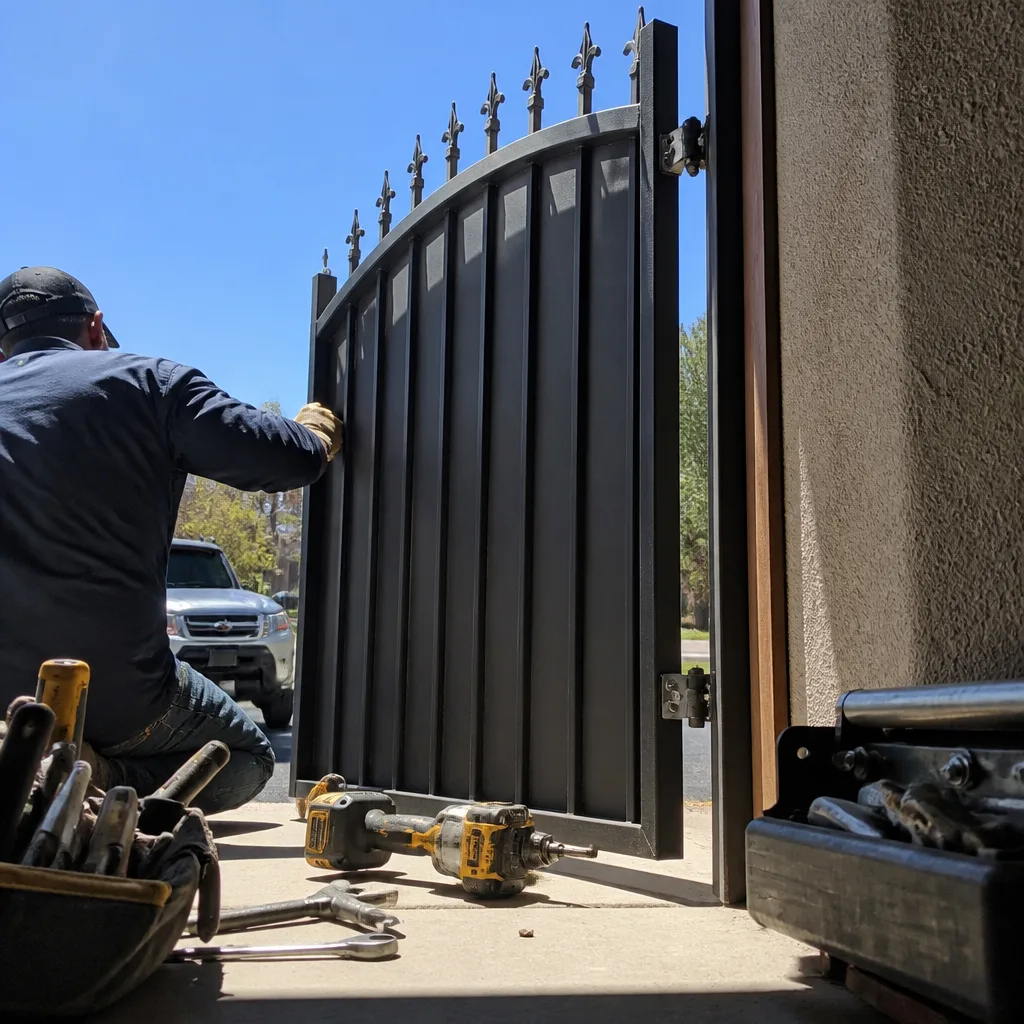
Some gate issues are genuinely hazardous and should not be approached without training and equipment. Call a professional if:
- The gate is a slide gate with broken track or derailed rollers; these are heavy, momentum-loaded assemblies that can shift unexpectedly
- Any electrical work involves the 120V supply side, not just low-voltage control circuits
- Underground conduit fault is suspected; proper diagnosis requires insulation testing equipment and excavation knowledge
- The gate is automated and the manual release mechanism is seized; forcing it can damage the operator’s internal clutch
- You’ve received a quote for motor replacement without written diagnostic evidence of motor failure
Vance Gate Repair Scottsdale offers free estimates in Scottsdale. We’ll inspect the gate, identify the actual failure, and deliver a written scope and price before any work begins. Call (928) 363-3921. A live person answers 24 hours a day, seven days a week. No voicemail loop, no callback queue.
Frequently Asked Questions
Most residential gate repairs in Scottsdale range from $180 for a limit switch adjustment to $780 for underground electrical fault repair, with control board replacement running $580-$1,100 depending on brand and features. Every repair from Vance Gate Repair includes a written, itemized price before work starts, and our diagnostic fee is applied to the repair if you authorize it. Call (928) 363-3921 for an exact quote on your specific gate - estimates are free.
This pattern indicates a thermal problem: limit switch drift, control board capacitor degradation, or photo-eye interference from direct sun. In Scottsdale’s summer, motor housing temperatures can exceed 140°F by mid-afternoon. Components that test normal at 85°F fail at 130°F. We log temperature at time of failure as standard diagnostic practice. The fix is rarely motor replacement; it’s usually adjustment, shielding, or component upgrade to higher thermal rating.
Low-voltage diagnostic checks and visual inspection are safe for most homeowners. Any work involving the 120V supply, high-tension spring or counterbalance systems, or heavy gate panels that could shift should be handled by a trained technician. We don’t provide step-by-step electrical repair instructions because incorrect work on automated gates creates liability and injury risk. For safe, documented repair with written warranty, professional service is the appropriate choice.
A patch addresses the symptom you reported without inspecting related systems. A complete repair includes mechanical baseline (hinge torque, track alignment), electrical baseline (voltage, amperage), component condition assessment, and written documentation of all findings. Ask specifically: “What did you measure, and what were the readings?” If the technician can’t answer with numbers, you’re likely getting a patch. Under The Haven Standard, we provide that documentation on every visit.
Keep the written scope and price, any wiring diagram or connection record, the limit switch and adjustment settings, and photographs of all work performed. This documentation prevents paying twice to rediscover the same problem and provides baseline data for future maintenance. We deliver this packet on every Vance Gate Repair visit under Clause 4 of The Haven Standard.
A quality gate motor in Scottsdale should last 12-18 years if the mechanical and electrical systems supporting it are maintained. Motors fail early when they’re forced to compensate for binding hinges, drifting limit switches, or voltage problems they weren’t designed to overcome. The motor outlasts three hinge sets and two control boards in typical service. Premature motor replacement usually means the actual failure was never diagnosed.
The Bottom Line
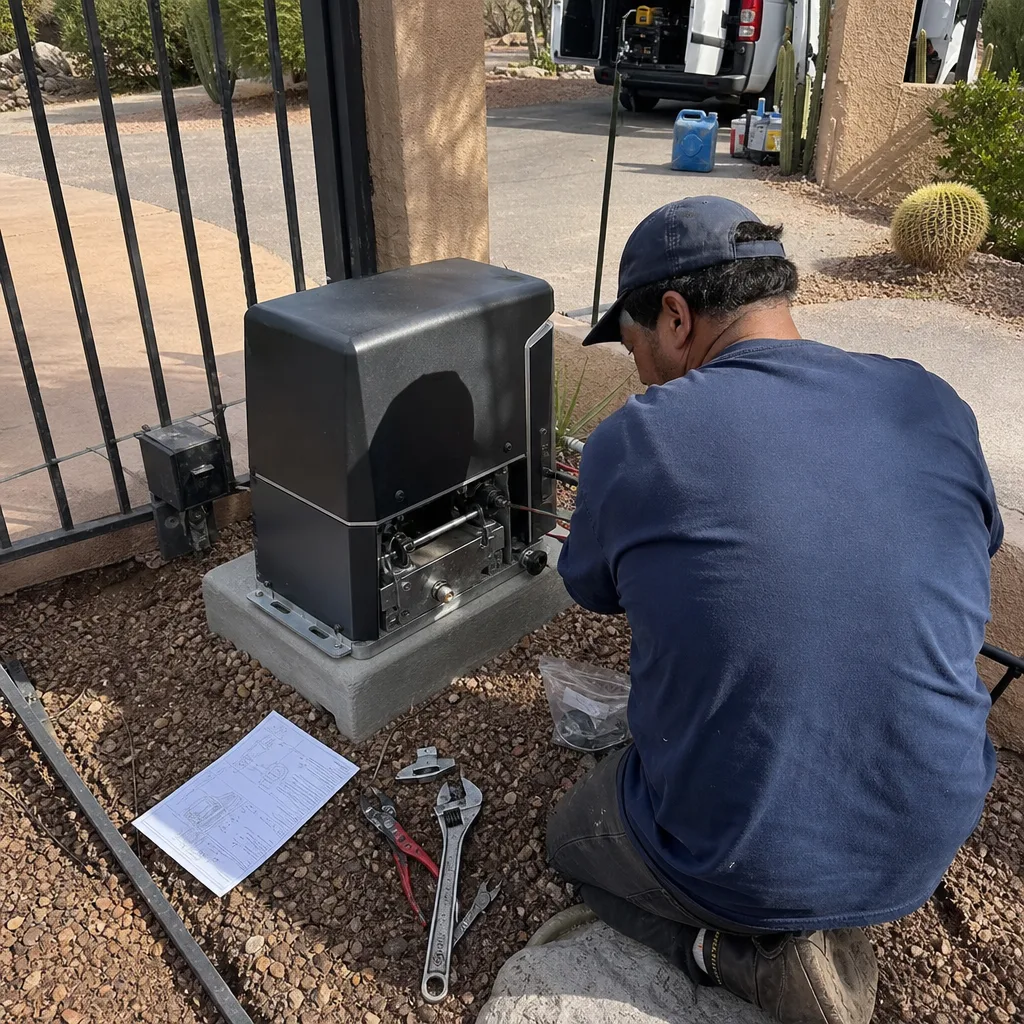
Gate repair in Scottsdale is not about replacing parts until something works. It’s about reading the failure chain correctly: limit switches first, ground-level hardware second, control board and wiring third, motor last. The desert climate accelerates specific degradation modes that technicians from temperate regions miss. Complete repair includes written scope, written price before work starts, and photographic documentation of every finding and adjustment. Anything less is a patch that guarantees a callback. For homeowners who’ve already read the three-star reviews and want transparency, the standard is simple: show me what you found, show me what it costs, show me what you left behind.
Written by Adrian Vance, Owner at Vance Gate Repair Scottsdale, serving Scottsdale since 2014.